
The Challenge
Traditionally, many gasket components have been manufactured entirely from metal. While proven reliable, this approach can present several challenges:
- Longer lead times for complex or bespoke components
- Higher material waste
- Limited flexibility for rapid design changes
- Growing customer demand for lighter, more adaptable solutions
Alba identified an opportunity to complement traditional machining with a manufacturing method that could improve flexibility, efficiency, and sustainability, without compromising performance.
The Solution: 3D Printing
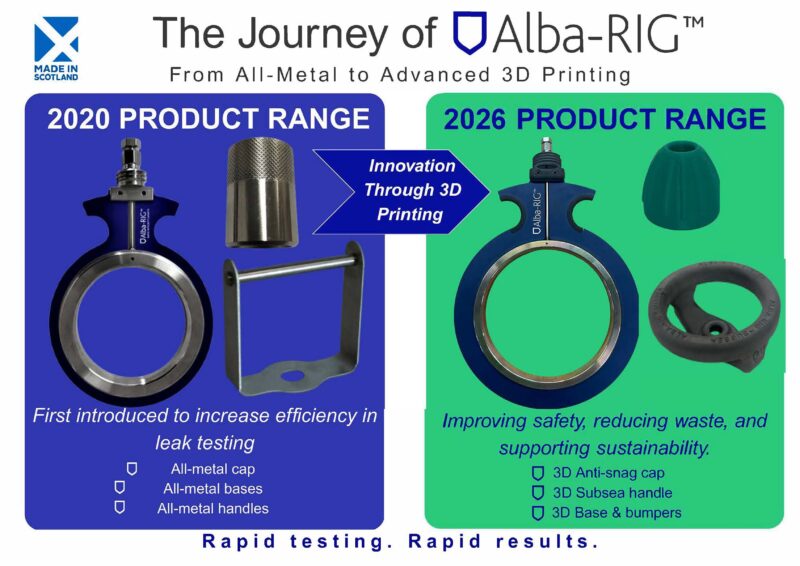
With funding support from the Energy Transition Zone (ETZ), Alba invested in 3D printing technology to support the development and manufacture of their RIG gasket components and associated parts. Additive manufacturing allows components to be produced directly from digital designs, enabling faster turnaround and greater design freedom.
The initial 3D printed range includes:
- Anti-snag caps
- Bumpers
- Bases
- Diver handles
These components are designed to integrate seamlessly with existing gasket systems while meeting Alba’s established performance and quality standards.
Technical Design Benefits
The introduction of non-metallic, 3D printed components has enabled several design improvements:
- Non-metallic components help eliminate galvanic corrosion issues
- An anti-rotation base prevents the test port from rotating when multiple adapters are connected to the test hose
- Directly supports the test port, rather than the test port tubing, this improves side-load capability when using heavy test hoses or operating in water currents
- Simplified assembly while mitigating galvanic corrosion between the outer ring and the bolts
Results & Benefits
The move to 3D printing has delivered clear advantages:
- Reduced lead times for prototypes and low-volume components
- Greater design flexibility, allowing complex geometries to be produced efficiently
- Faster design iteration and product refinement
- Reduced material waste compared to traditional subtractive manufacturing
- A complementary approach that bridges additive manufacturing with conventional machining
Sustainability Impact
3D printing supports Alba’s sustainability goals by:
- Using only the material required for each component
- Reducing waste during manufacturing
- Supporting lighter component designs where appropriate
This represents an important step towards greener manufacturing within the gasket industry and the wider oil and gas sector.
Looking Ahead
As Alba moves into 2027, the introduction of 3D printing positions the company to respond more quickly to customer requirements, support ongoing product development, and remain competitive in a changing market.
By combining additive manufacturing with established engineering expertise, Alba continues to deliver innovative and reliable, Rapid Integrity gasket solutions, designed for the challenges of today and the future.